
In the documented demo, interact with a marked fishing spot, select suitable tackle and bait, and cast into active water. After a bite, respond to the fish's direction while watching stamina and line tension, then use the landing prompt when it appears. Predator lures need movement, and your installed build's tutorial should determine the exact reeling timing.
October 2026 demo; Early Access parity not tested. Research checked November 9, 2026.
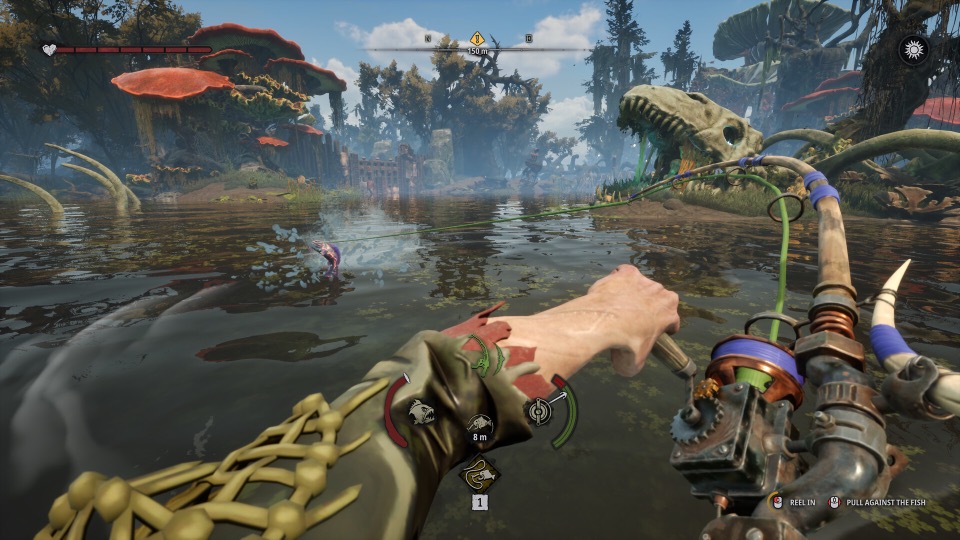
Official Steam screenshot · Dream Dock / Digital Vortex Entertainment. Illustrative media; material statement.
Start fishing from a designated spot
The collected fishing coverage describes entering fishing through a marked location. Player reports also distinguish that interaction from trying to equip a rod anywhere during ordinary exploration. If you have the rod but cannot begin, check the spot interaction before concluding that the equipment itself is missing.
The early demo introduction takes the player through this process rather than leaving every fishing action to discovery. Read its prompts at the point where the game changes from exploration into the fishing interaction. A screenshot of another build's inventory is not enough to establish that its controls match the version you are playing.
Once the spot is active, inspect the fish information available there. A location relevant to a current objective and tackle suited to its target are both part of preparing the catch. Selecting a bait without checking the intended species can send you into the wrong troubleshooting path when no bite follows.
Match the bait to the introductory fish
The documented starting pairings are Earthworm for Snapper, Wind-Up Tin for Softgrazer and Rainbow Fin for Harpooner. These pairings support the early demo objectives and should not be read as a complete bait database. The bait guide lists the supported crafted-lure recipes separately from the general fishing technique.
Wind-Up Tin and Rainbow Fin are crafted at the workbench after their unlocks. That means knowing a recipe and having permission to craft it are different checks. If the required lure is not available, return to the relevant unlock and station rather than assuming any fish can be caught with the tackle already selected.
The location question remains separate from this equipment check. The starting Snapper platform is documented behind the Dry Dock, while the later peaceful-fish and predator objectives direct the player through their markers. See fish locations for that limited introductory route rather than an unsupported coordinate map.
Keep a predator lure moving through active water
Predatory fishing involves attracting the fish before the hooked-fish struggle begins. The Harpooner material describes retrieving Rainbow Fin through an active splash zone at a pace the fish can follow. A lure left motionless or retrieved too quickly can lose that chase before a bite happens.
Watch which stage actually failed before changing anything. If the predator followed without taking the lure, the supplied evidence points to the attraction stage rather than a fight against line tension. If the fish has already bitten and then escapes, you need to examine the hooked-fish interaction instead.
The research does not establish a universal retrieval speed or a guaranteed catch percentage. It supports controlled movement and paying attention to the predator's response. Treat those observations as a way to understand the interaction, not as a promise that holding one input for a fixed duration will always work.
Read stamina and line tension as different signals
Once the fish is hooked, the demo coverage describes a struggle involving movement, stamina and tension. Responding to the fish's direction is part of controlling that struggle, while excessive line tension creates a separate failure risk. Do not interpret every movement of the fish as a reason to continue pulling without checking the meters.
Ease off before the line overloads, following the prompts and feedback shown by your version. The source notes deliberately exclude one universal tire-then-reel sequence because later rule changes were reported without a fully verified rollout. That is why this guide describes the roles of the signals rather than prescribing an old timing pattern for all builds.
If advice from a video disagrees with your tutorial, identify the video's build before copying its inputs. A demonstration can show a genuine catch in an older version while still being the wrong control reference for your installation. Use the currently displayed prompts to decide when to reel, counter movement or release pressure.
Finish with the landing prompt
Bringing the fish close is not presented as the final action on its own. The documented technique includes using the landing prompt once it becomes available. Continue reading the interface near the end of the struggle instead of assuming that distance alone completes the catch.
This last stage also helps distinguish two common descriptions of failure. A fish lost during attraction has not yet reached the same state as one lost after being hooked. A catch that reaches the landing interaction needs attention to that prompt, which is another reason to describe the symptom precisely when asking for help.
Diagnose the symptom before replacing equipment
For a rod that seems unusable, check whether you entered the designated fishing interaction. For a predator that will not bite, review the species, lure and retrieval stage. For a fish that bites but escapes, review tension, movement and the landing prompt shown by the current build.
A stronger rod is not established as the universal answer to these different problems. Nor do the supplied notes verify an FPS setting or system tweak that fixes every lost fish. Keep those claims separate from the supported demo mechanics, and use the Harpooner guide when that specific predator is blocking your progression.
Sources and research scope
This article synthesizes the supplied research document dated November 9, 2026. Demo instructions are attributed to the recorded builds; no hands-on Early Access playthrough is claimed.
Found a build-specific difference? Send a correction with the objective wording and game version.